Steam, Silence, and Strangers: Why Americans Are Finding Their People Inside Turkish Hammams
The Loneliness Epidemic Nobody Wants to Talk About
Let's be honest: America is lonely. The US Surgeon General declared it an epidemic back in 2023, and the numbers haven't exactly improved since. We've got more ways to "connect" than ever — group chats, comment sections, co-working spaces — and yet something keeps feeling hollow. So it's a little surprising, and maybe a little poetic, that one of the most talked-about wellness trends sweeping cities like New York, Los Angeles, and Chicago isn't an app or a supplement. It's a 600-year-old bathing ritual from Anatolia.
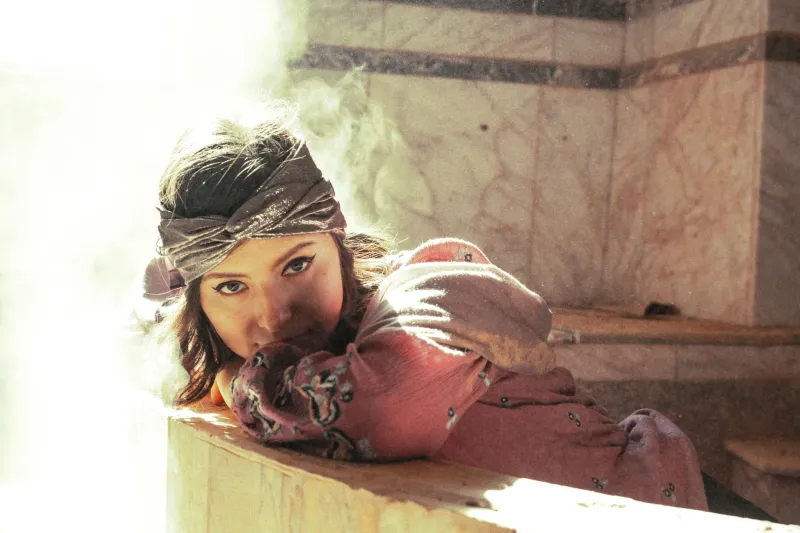
The hammam — the traditional Turkish bathhouse — has been part of daily life across Turkey and the broader Middle East for centuries. It was never just about getting clean. It was where you went to slow down, where neighbors became confidants, where the ritual of being cared for by another person was built right into the architecture. Marble slabs. Domed ceilings with star-shaped skylights. The steady hiss of steam. And crucially: no phones.
Now, that ritual is landing in America at exactly the moment Americans seem to need it most.
What Actually Happens Inside a Hammam
If you've never been, the experience is worth describing because it genuinely catches first-timers off guard. You enter, you're given a thin cotton wrap called a pestemal, and you're led into a progressively warmer series of rooms. The centerpiece is the göbek taşı — literally the "navel stone" — a large heated marble platform where you lie down, let the heat seep into your bones, and wait.
Then comes the kese: a rough exfoliating mitt worked across your entire body by an attendant called a tellak. It sounds aggressive. It is, a little. And it is also, according to basically everyone who tries it, deeply, almost embarrassingly relaxing.
"People cry sometimes," says Defne Arslan, who co-owns Çarşı Hammam, a recently opened bathhouse in Brooklyn's Boerum Hill neighborhood. "Not from pain — from release. There's something about being physically taken care of by another person, in a warm room, with no agenda, that just breaks people open."
Arslan, who grew up in Istanbul and moved to New York in her late twenties, says she opened Çarşı partly out of homesickness and partly out of frustration. "I kept going to American spas and feeling more isolated than when I walked in. Everyone's in their own little room, whispering, avoiding eye contact. The hammam is the opposite of that."
The Community Architecture That Got Lost
What Arslan is describing is something urban planners and sociologists call "third places" — spaces that are neither home nor work, where community forms organically. The corner bar used to be one. The barbershop. The church hall. These spaces have been disappearing for decades in the US, replaced by private consumption and curated digital communities that, it turns out, don't scratch the same itch.
The hammam was always a third place, by design. In Ottoman cities, bathhouses were built near mosques, markets, and caravanserais — the social infrastructure of daily life. Rich and poor, old and young, entered the same steam. The ritual leveled things out.
"There's a democratizing quality to it," says Dr. Leyla Yıldırım, a cultural anthropologist at NYU who studies wellness practices across immigrant communities. "You strip away status markers. You're just a body in a warm room with other bodies. Americans are not used to that, and I think for a lot of people it's both terrifying and profoundly relieving."
Who's Actually Showing Up
Walk into any of the handful of authentic hammams that have opened across the US in the last three years and you'll find a striking mix of people. There are Turkish and Arab diaspora communities, obviously — for whom the hammam carries cultural memory and nostalgia. But there are also a lot of people who've never been to Istanbul or Marrakech, who found the place on TikTok or stumbled across it while looking for something more meaningful than a Swedish massage.
Marcus, a 34-year-old software engineer from Chicago who asked us not to use his last name, started going to a hammam on the North Side after his therapist suggested he find ways to "be present with other humans." He was skeptical. He is no longer skeptical.
"I go every two weeks now," he says. "I've started recognizing the regulars. We don't really talk much during the actual hammam part, but there's this lounge area after where people just... sit. And somehow that silence with strangers feels more connecting than most conversations I have online."
That lounge culture — the çay, or tea, that follows the bath, the unhurried sitting — is something hammam owners say they've had to actively protect from American efficiency culture. "People want to book a 45-minute slot and rush out," Arslan laughs. "We gently discourage that."
Mental Health in the Steam Room
Wellness experts are paying attention. The mental health benefits of heat therapy — reduced cortisol, improved sleep, muscle relaxation — are reasonably well-documented. But therapists who work with clients experiencing social isolation say the hammam's specific combination of physical warmth, communal space, and enforced tech-free time is doing something more layered.
"We know that touch is essential for human wellbeing and that touch deprivation is genuinely harmful," says Dr. Aisha Morel, a licensed therapist based in Los Angeles who has started recommending hammam visits to some clients. "The kese treatment involves sustained, caring physical contact from another person. For people who are isolated, that can be profoundly regulating for the nervous system in ways that are hard to replicate otherwise."
She's careful to note that a hammam isn't therapy. But as a complement? She's seen results.
Something Ancient, Something Needed
There's a version of this trend that gets flattened into a lifestyle piece about the hottest new spa experience. And sure, hammams are having a moment on Instagram and the prices at some of the upscale versions in Manhattan reflect that. But talk to the people who keep coming back — the regulars, the diaspora members who grew up with this, the first-timers who walked in skeptical and left changed — and something more interesting emerges.
The hammam works because it was never designed to be a product. It was designed to be a place. A place where the act of being human together — sweaty, vulnerable, unhurried — was the whole point.
In a country where loneliness has become a public health crisis, that might be the most radical thing on offer.
You just have to be willing to leave your phone at the door.