Friday Prayers, Brooklyn Coffee, and Breathwork: How Turkish and Arab Americans Are Building a New Kind of Spiritual Home
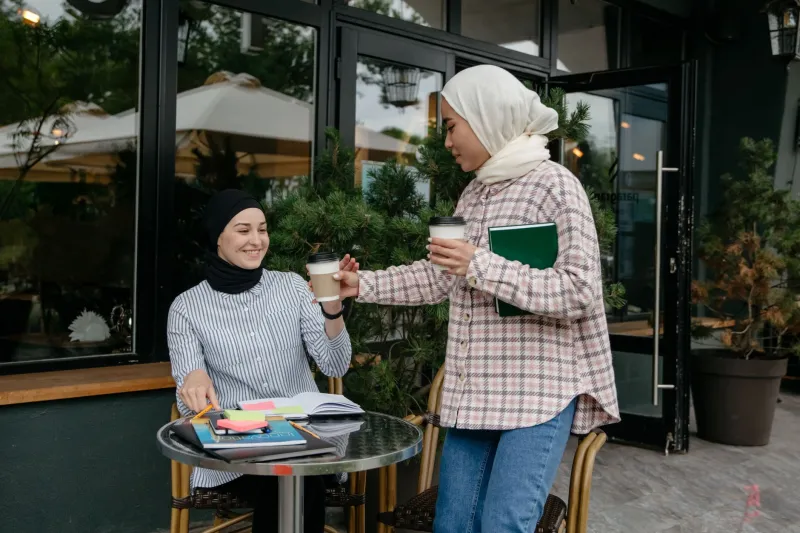
On a Tuesday evening in Astoria, Queens, about a dozen people are crowded around pushed-together tables at a Turkish café that smells like cardamom and fresh bread. There are laptops open, çay glasses being refilled, and somewhere between the hum of conversation and the background noise of the street outside, someone is reading aloud from the Quran.
This is not a mosque. It's not a community center. There's no formal imam, no prayer rugs, no structured liturgy. What it is, says the woman who organized it — a 31-year-old Turkish-American named Selin who works in tech and has been running these informal gatherings for two years — is "just a place where we can be Muslim and American and still figuring it out, all at the same time."
Scenes like this are playing out in cities across the US, from Houston's sprawling Arab-American neighborhoods to the Turkish enclaves of Paterson, New Jersey, to the more dispersed diaspora communities of Chicago and Los Angeles. Turkish and Middle Eastern immigrants — and their American-born children — are quietly building spiritual lives that don't conform to traditional institutional religion or to the secular wellness culture that dominates mainstream American life. They're doing something more interesting: blending the two.
The Mosque Isn't Enough — And Neither Is the Yoga Studio
For many Turkish and Arab Americans, the local mosque fills an important function. It's a place of worship, yes, but also a community anchor — a space where you can hear your language, find your people, mark the holidays that matter to you. But for a growing segment of the diaspora, especially younger generations and recent arrivals navigating the particular disorientation of immigrant life in 2024 America, the mosque alone doesn't address everything they're carrying.
"I love my masjid," says Omar, a 28-year-old Palestinian-American in Chicago. "But it's not really a place I can go when I'm having an existential crisis at 10pm on a Wednesday. It's not designed for that."
And the American wellness industry — the meditation apps, the breathwork workshops, the sound bath studios — often feels like it's speaking a language that doesn't quite translate. The mindfulness movement draws heavily on Buddhist and Hindu traditions, and while many of its practices have genuine value, they can feel culturally alienating for people whose own tradition has a rich, largely underrepresented contemplative history.
"Islam has Sufism," says Dr. Amina Celik, a Turkish-American scholar of Islamic philosophy based in Boston. "It has dhikr, it has whirling, it has centuries of sophisticated thought about the inner life, about the relationship between the self and the divine. That's not something that needs to be replaced by a wellness app. It needs to be rediscovered."
Sufi Philosophy Meets the American Wellness Moment
Dr. Celik has spent the past several years working on exactly that rediscovery. She runs a series of workshops — held in rented studio spaces, community centers, and occasionally people's living rooms — that introduce participants to Sufi concepts like fana (self-dissolution), tawakkul (radical trust), and the use of breathwork and repetitive movement as pathways to contemplative states. The workshops draw Muslims and non-Muslims alike, and they consistently sell out.
"People are hungry for something that goes deeper than a productivity hack dressed up as mindfulness," she says. "And for people from the diaspora especially, there's something incredibly grounding about realizing that your own tradition already has all of this. You don't have to go borrow someone else's spiritual vocabulary."
This sentiment echoes across the communities İst Dünya spoke with for this piece. Again and again, people described a kind of spiritual homecoming — not a return to a rigid or inherited religiosity, but a reengagement with the depth of their own tradition on their own terms.
Tea, Text, and Community: The Informal Gathering as Sacred Space
Back in Astoria, Selin's Tuesday gathering has been running long enough to develop its own rhythms. Someone brings börek most weeks. There's usually a text — a Quranic passage, a poem by Rumi or Yunus Emre, occasionally something from a contemporary Muslim thinker — and then conversation. Real conversation, the kind that wanders into doubt and grief and politics and joy and comes back around to something that feels, in the end, like prayer.
"We talk about everything," Selin says. "Dating. Immigration stress. What it means to fast when you work a nine-to-five in America. Whether you can be a good Muslim and also be really angry at some of the things done in Islam's name. Nobody has to have it figured out."
The format — informal, text-based, held in a secular space — is reminiscent of a halaqah, the traditional Islamic study circle. But it's also something distinctly new, shaped by the specific experience of being Muslim and Middle Eastern in contemporary America, where your faith is frequently misunderstood by the broader culture and your cultural identity is often flattened into a monolith.
Similar gatherings are happening in Arab-American communities across the country. In Dearborn, Michigan — home to one of the largest Arab-American populations in the US — community members have organized everything from Quran study groups in coffee shops to outdoor iftar dinners that draw neighbors of every background. In Houston, a Yemeni-American wellness entrepreneur runs retreats that combine Islamic contemplative practices with somatic therapy, drawing participants who are processing both the ordinary difficulties of immigrant life and the specific trauma of watching their home country at war.
Navigating Identity Without Losing Faith
For many in the diaspora, the spiritual work is inseparable from the identity work. Being Turkish or Arab in America means constantly negotiating between worlds — between the culture you came from and the one you live in, between the version of yourself your family recognizes and the version that makes sense in an American context.
Faith can be a throughline in that negotiation, but it can also be a site of tension. Some diaspora communities hold tightly to inherited religious practices as a way of preserving cultural identity; others find those same practices feel constraining in a new context. The most interesting thing happening right now, from where we're sitting, is the generation that's refusing to choose.
"I'm not going to perform being a 'good Muslim' for my parents and then secretly live a completely different life," says Nour, a 26-year-old Lebanese-American in Los Angeles. "And I'm not going to just abandon everything either, because my faith is actually real to me. So I'm trying to figure out what it looks like to be both — fully — at the same time."
That figuring out, messy and ongoing as it is, looks like the Astoria tea circle. It looks like a Sufi breathwork workshop in a rented Brooklyn studio. It looks like a group of Turkish-American friends doing Ramadan together in a city where nobody around them is fasting, holding something sacred in the middle of ordinary American life.
It doesn't look like anything that existed before. It looks like exactly what it is: a community making space for itself, one gathering at a time.