Eating at Midnight Isn't a Bad Habit — It's a Whole Culture
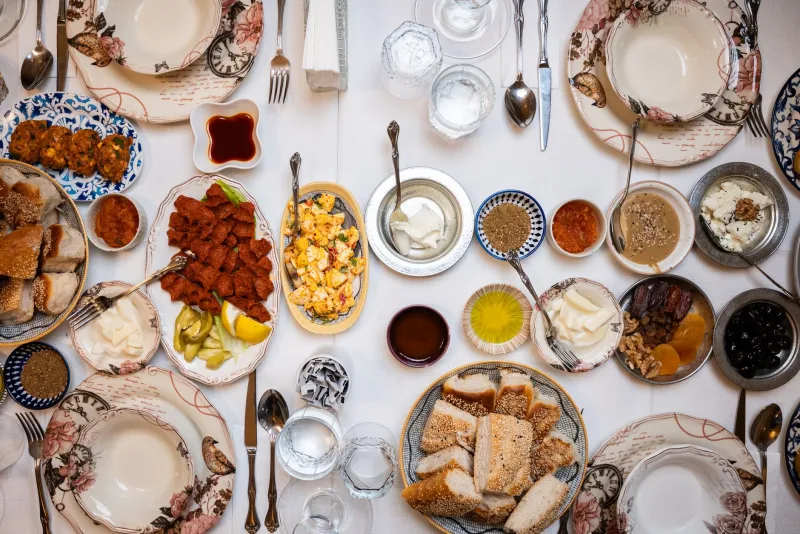
Somewhere between the last episode of a Turkish dizi and the first call to prayer, a table gets set. Olives, white cheese, fresh bread, maybe some leftover lentil soup reheated with a splash of olive oil. No one planned it. No one made a reservation. It just... happened. If you grew up in a Turkish or Arab household, you know exactly what this looks like. And if you didn't — well, America is slowly starting to figure it out.
The midnight meal isn't a guilty snack. It's not a cheat day. In much of the Middle East and Turkey, late-night eating is a full-on social institution, and it's quietly starting to reshape how younger Americans think about when — and why — we eat.
The Sehri Effect
For Muslims, sehri (also called suhoor in Arabic) is the pre-dawn meal eaten before the Ramadan fast begins. But ask anyone who's grown up with it, and they'll tell you it's so much more than calories before a long day. It's the hushed intimacy of a kitchen at 3 AM, the smell of eggs frying while the rest of the world sleeps, the feeling that you're part of something bigger than your own hunger.
"Sehri was the meal I looked forward to most as a kid," says Leila Arslan, a 29-year-old food blogger based in Chicago whose parents immigrated from Gaziantep. "Everyone's tired, everyone's a little delirious, and somehow that makes the food taste better. There's no performance to it. You're just eating together."
That lack of performance — the anti-dinner-party energy of it — is exactly what's resonating with a generation of Americans who are exhausted by curated food experiences. Gen Z, in particular, has grown deeply skeptical of the performative meal: the aesthetically plated dishes, the Instagrammable restaurant lighting, the pressure to be "on." The sehri table, by contrast, is the opposite of all that. It's functional, warm, and completely unpretentious.
Mezze After Midnight
Beyond Ramadan, late-night eating is simply woven into the social fabric of Turkish and Arab life. In Istanbul, it's not unusual to sit down to a proper mezze spread at 10 or 11 PM. In Beirut — before and after its many upheavals — restaurants would only really come alive around midnight. The idea that dinner should be wrapped up by 7:30 so you can watch TV and be in bed by 10 is, frankly, a foreign concept.
And it's a concept that more American restaurant owners with roots in the region are starting to push back against.
Omar Khalil opened his Lebanese-Turkish fusion spot in Astoria, Queens, three years ago with a deliberate late-night menu that doesn't start until 9 PM on weekends. "I got pushback at first," he admits. "People said Americans don't eat that late. But I knew my community did. And I had a hunch that younger Americans were ready for something different."
He was right. His late-night mezze hours — small plates, shared dishes, strong tea, and the occasional arak — now draw a crowd that's a mix of diaspora regulars and curious locals in their 20s and 30s. "The vibe is different when you eat late," Omar says. "People slow down. They actually talk to each other."
A Nutritionist's Take (That Might Surprise You)
The conventional American wellness narrative has long insisted that eating late is the enemy — a one-way ticket to poor sleep and weight gain. But that story is getting more complicated.
Dr. Selin Yıldız, a registered dietitian in Los Angeles who works primarily with Turkish and Arab American clients, says the framing matters enormously. "When we talk about 'late-night eating' in the American context, we usually mean mindless snacking alone in front of a screen," she explains. "That's very different from a communal meal with real food and real conversation, which is what sehri or a late mezze gathering actually looks like."
She notes that for her clients who observe Ramadan, the social and spiritual dimensions of sehri often outweigh any physiological concerns about meal timing. "The research on intermittent fasting and time-restricted eating is actually pretty aligned with how Ramadan works," she adds. "The body adapts. What matters more is the quality of the food and the quality of the experience."
That reframe — quality of experience as a nutritional variable — is something younger Americans seem increasingly receptive to. Eating alone at a reasonable hour, it turns out, might be worse for you in ways that a calorie count can't capture.
The Loneliness Problem on a Plate
America has a well-documented loneliness crisis. Surgeon General advisories, think-piece avalanches, the whole thing. And while the causes are complex, one contributing factor that doesn't get enough attention is how isolated American eating culture has become. We eat at desks. We eat in cars. We eat in front of laptops with noise-canceling headphones on. We eat, in other words, alone.
The late-night communal meal is a direct antidote to that. It's hard to eat mezze alone — the whole point is the sharing. It's hard to rush a sehri — the whole point is the slowness.
"I started hosting late-night dinner nights with my friends after I visited my Turkish roommate's family," says Marcus Webb, a 26-year-old from Atlanta who now lives in Brooklyn. "We'd just put out a bunch of stuff — cheese, bread, dips, whatever — and eat at like 11 PM after everyone got off work. It became the thing we looked forward to most all week."
Marcus doesn't observe Ramadan. He has no Turkish or Arab heritage. But he stumbled into a centuries-old tradition and found something he didn't know he was missing.
Setting the Table Later
Restaurants in cities like New York, LA, Chicago, and Houston are quietly extending their hours to meet this shift. Late-night mezze menus are showing up in spots that wouldn't have considered them five years ago. Sehri pop-ups during Ramadan have become genuine cultural events, drawing crowds that stretch well beyond Muslim communities.
And on social media, the sehri aesthetic — soft kitchen lighting, steam rising from tea glasses, hands reaching across a crowded table — has developed a visual language all its own. It's cozy without being precious. Intimate without being exclusive.
The midnight feast isn't asking you to overhaul your schedule or adopt a religion or move to Istanbul. It's just suggesting, gently, that maybe the best meal of the day doesn't have to happen when it's still light outside.
Set the table a little later. See who shows up. See what happens.
The olives will be there. The tea will be hot. And the conversation — well, that's the whole point.