Flour, Family, and the Long Game: How Turkish and Arab Family Businesses Are Quietly Building Empires in America
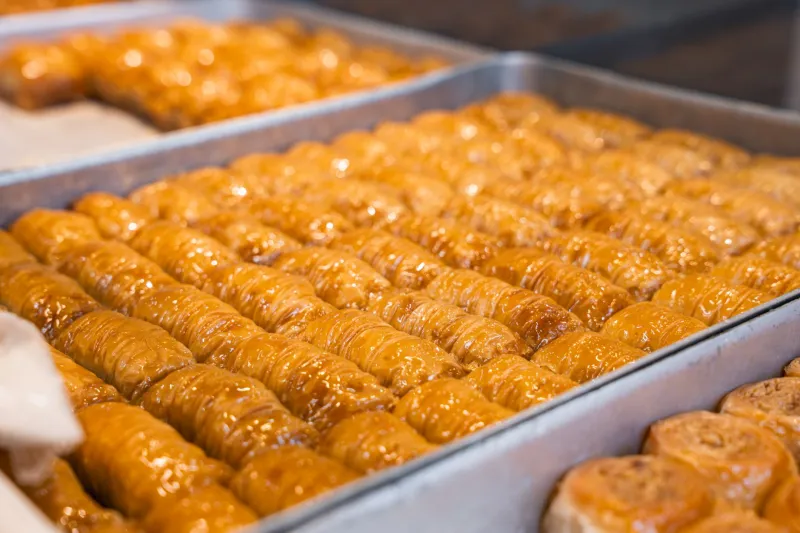
The baklava at Selim's Pastry in Paterson, New Jersey has not changed in 31 years. The recipe came over in a notebook from Gaziantep. The pistachios still get sourced from the same importer the family has used since 1994. The phyllo is still pulled by hand every morning at 5 a.m. by a rotation of family members who have been doing it since they were teenagers.
Selim's now has four locations, a wholesale operation supplying restaurants across the Northeast, and a waiting list for holiday orders that extends to mid-October. The founder's son, who runs the business now, has turned down two acquisition offers from regional food conglomerates.
"They wanted to change the pistachio supplier," he says, with a finality that suggests the conversation ended there.
A Different Model of American Success
The conventional American business narrative loves a certain shape: a founder with a disruptive idea, venture capital, rapid scaling, an IPO or a nine-figure acquisition. It's a compelling story, and it gets told constantly. What gets told less often is the story of patient capital — businesses built over decades, across generations, using a completely different set of principles.
Turkish and Arab American family businesses represent one of the most consistent examples of this alternative model in the United States. From baklava shops in New Jersey to halal butcher empires in Michigan to multi-generational import businesses in Texas, these enterprises share a set of characteristics that don't map neatly onto the MBA playbook — and that's precisely why they work.
They're slow to expand and quick to protect quality. They treat supplier relationships like family relationships, because sometimes they literally are. They reinvest profits rather than distribute them. And they operate with a time horizon measured in decades, not quarters.
The Trade Secret Economy
In many of these businesses, the core competitive advantage is something that can't be patented or replicated easily: proprietary knowledge held within the family and passed down through apprenticeship rather than documentation.
A spice blend. A specific ratio in a dough recipe. A curing technique for a particular meat. The exact temperature at which a certain syrup must be poured for baklava to achieve its distinctive texture. These are not written down anywhere that outsiders can access. They exist in the hands and memories of family members who learned by watching and doing.
This is not an accident or a quirk. It's a deliberate strategy, even if it was never articulated as one. In cultures where formal intellectual property protection wasn't always available or reliable, the recipe itself became the asset — and keeping it within the family was how you protected it.
"My mother never let anyone outside the family watch her make the filling," says the owner of a Lebanese sweets shop in Dearborn, Michigan, whose business has been operating for 22 years. "Not because she was secretive for the sake of it. Because that filling is why people come. It's the whole business."
Community as Infrastructure
Another defining feature of these businesses is their relationship with their immediate communities — relationships that function, in economic terms, almost like infrastructure.
The Turkish or Arab-owned grocery store in a diaspora neighborhood isn't just a retail operation. It's a credit system (the owner knows which families are going through hard times and adjusts accordingly), a social hub, a source of trusted product recommendations, and often a de facto employment agency for newly arrived community members who need a first job while they find their footing.
This community embeddedness creates a kind of loyalty that no marketing budget can replicate. Customers who have been buying their olives from the same family-run import shop for fifteen years aren't going to switch because a bigger chain offers a slightly lower price. The relationship has value that transcends the transaction.
For the businesses themselves, this means a stable customer base that weathers economic downturns better than most. During the pandemic, several Turkish and Arab-owned food businesses in major American cities reported that their core community customers actually increased their purchasing to support them — a form of informal economic solidarity that doesn't show up in any business school case study.
The Second Generation Pivot
What makes the current moment particularly interesting is what's happening as second and third-generation family members take over or expand these businesses. They're arriving with American business educations, digital fluency, and access to capital markets their parents never had — but they're choosing, largely, to apply those tools in service of the original model rather than to disrupt it.
A Turkish-American woman in Brooklyn who took over her family's import business after getting her MBA from NYU spent her first two years building out an e-commerce operation — but specifically to extend the family's existing wholesale relationships online, not to replace them. "My dad built this on trust," she explains. "I'm not going to blow that up for a better conversion rate."
Elsewhere, second-generation entrepreneurs are using social media not to chase virality but to tell the story of the business — the origin, the family, the craft — to a new audience that has developed an appetite for exactly that kind of authenticity. A third-generation baklava maker in Chicago who posts videos of the 5 a.m. phyllo-pulling process has built a following of 180,000 people, most of whom are not from the community. They're Americans who found the process beautiful and the story compelling.
Patience as Competitive Advantage
Perhaps the most counterintuitive thing about these businesses, from a contemporary American perspective, is that their slowness is a feature, not a limitation.
In an economy increasingly defined by disruption cycles that compress business lifespans, the family business that has been making the same product the same way for thirty years is genuinely rare. That rarity has value. It signals quality, consistency, and trustworthiness in a marketplace full of brands that appeared two years ago and may be gone in two more.
The baklava at Selim's tastes exactly the way it tasted in 1993. The pistachios are still from the same importer. The phyllo is still pulled by hand at 5 a.m.
That's not stubbornness. That's a business strategy built on a thirty-year proof of concept — and it's one that a lot of American entrepreneurs, drowning in pivots and pivots and pivots, might find worth studying.