Something Borrowed, Something New: How Turkish and Arab Americans Are Reinventing the Way They Find Love
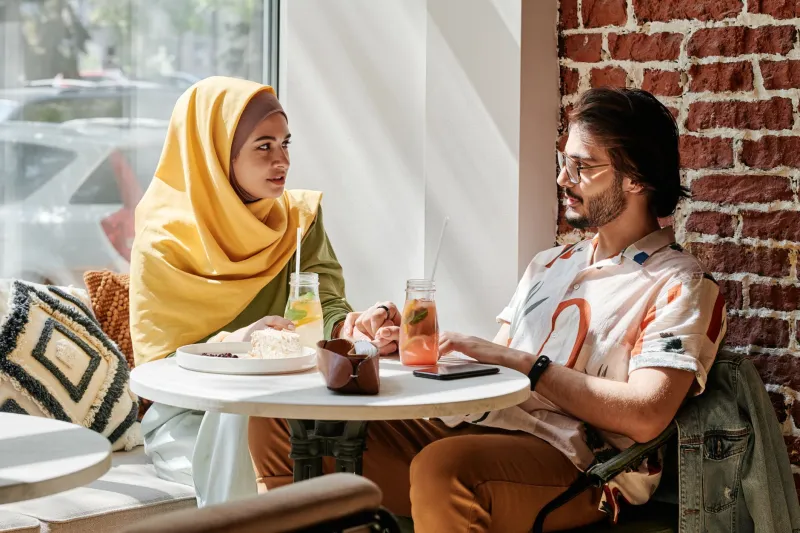
Somewhere between a family WhatsApp group full of unsolicited matchmaking suggestions and a Hinge profile optimized for the algorithm, a new generation of Turkish and Arab Americans is carving out its own definition of how love should begin.
It's not a clean break. It's not a revolution. It's something messier, more human, and honestly — more interesting than either extreme.
The Old System Had Real Logic
Before we call anything outdated, it's worth understanding what arranged marriage culture actually looked like for most families — not the coerced, no-say version that Western media loves to dramatize, but the more common reality: a community-assisted introduction system built on trust, reputation, and shared values.
"My parents didn't pick each other off the street," says Nadia, a 29-year-old Lebanese American from Dearborn, Michigan. "Their families knew each other. There was vetting. There was accountability. It wasn't romantic in the Hollywood sense, but it wasn't cold either."
For generations, this system worked because it operated within tight-knit communities where everyone knew everyone. The mosque, the cultural association, the summer picnic — these weren't just social events. They were infrastructure.
Then the infrastructure started to crack.
What Actually Changed
Diaspora life does something specific to community density. Families spread out. Kids go to college across the country. The cousin who might have introduced you to someone perfect now lives in Seattle and hasn't been back to the old neighborhood in three years.
Dr. Layla Osman, a therapist in the Chicago area who works primarily with Arab American clients, puts it plainly: "The network shrank, but the expectations didn't. That gap created enormous pressure — especially on women."
Add to that the generational weight of growing up American. Turkish and Arab American kids who went through US public schools, absorbed the same pop culture, sat through the same health classes, and internalized the same ideas about individual choice — they didn't arrive at adulthood ready to hand the steering wheel to their families without at least wanting a say in the directions.
"I love my parents," says Tariq, a 32-year-old Turkish American software engineer in Austin. "I also knew by age 22 that I needed to find someone myself. Not because their way was wrong, but because I'm wired differently. I needed the story to be mine."
The App That Tried to Bridge Everything
Enter Muzz — formerly Muzmatch — the halal dating app that's quietly become one of the more fascinating social experiments in diaspora tech. With millions of users worldwide and a growing American base, Muzz operates in a space most mainstream apps ignore entirely: the overlap between religious observance, cultural expectation, and the desire for genuine connection.
The app lets users set their own parameters — how religious they are, whether family is involved in the process, what they're looking for. It's essentially trying to digitize the community matchmaking function that geography eroded.
"Muzz gave me a way to be honest about who I am before I even had a first conversation," says Selin, a 27-year-old Turkish American in New Jersey. "On regular apps, you're performing. On Muzz, everyone already understands the context. It's a different energy."
Not everyone loves it. Critics within the community say apps flatten nuance — that a profile can't capture what a family introduction could. Others worry that the gamification of swiping is fundamentally at odds with the intentionality that made traditional matchmaking meaningful.
Both critiques have merit. And both miss the point slightly.
The Hybrid Model Nobody Talks About
What's actually emerging isn't a clean switch from one system to another. It's a hybrid — and it's more common than anyone publicly admits.
Young people are meeting on their own terms, through apps, through friends, through work. Then, once something serious develops, they bring their families in. The family vetting still happens — it's just moved from the beginning of the process to somewhere in the middle.
"I met my fiancé on Instagram, of all places," laughs Rima, a 30-year-old Syrian American in Houston. "But before we got engaged, both families met, both families approved, both families were part of the conversation. We just didn't need them to make the introduction."
Dr. Osman sees this pattern constantly in her practice. "What I tell families is: the values you want to preserve — commitment, community involvement, compatibility — those can survive in a new process. What doesn't have to survive is the specific mechanism."
The Tension Is Still Real
None of this is frictionless. Therapists working with Turkish and Arab American clients report that marriage and family expectations remain one of the top sources of intergenerational conflict — right up there with career choices and religious practice.
Parents who genuinely believe they know what's best for their children aren't villains. They're operating from a framework that served their parents and, in many cases, served them. Asking them to let go of that framework requires more than a conversation — it requires trust, and trust takes time.
For many young people, the path forward involves a lot of translation — not of language, but of intent. Explaining to a mother that you want to find someone yourself doesn't mean you're abandoning her values. Explaining to a father that you're using an app doesn't mean you're not serious.
"The hardest part wasn't meeting someone," Tariq admits. "It was convincing my family that the way I met him was valid."
Him. Worth noting that for LGBTQ+ Turkish and Arab Americans, this conversation carries a weight that's almost incomparable — navigating not just the how of partnership but the who, within communities where that remains deeply contested territory.
What Love Actually Looks Like Now
At the end of the day, what's happening in Turkish and Arab American communities isn't a rejection of culture. It's culture doing what culture has always done: evolving under pressure, absorbing new influences, and finding ways to survive.
The arranged marriage system, at its best, was never really about control. It was about care — the community's attempt to make sure its members weren't left alone to navigate one of life's most consequential decisions without support.
That impulse hasn't gone anywhere. It's just taking new shapes — a family group chat, a Muzz profile, a long dinner where everyone pretends they're not sizing up your partner but absolutely are.
Something borrowed. Something new. Something that's still, unmistakably, theirs.