Ink Deep: The Arabic and Ottoman Script Tattoo Boom That's Rewriting America's Body Art Scene
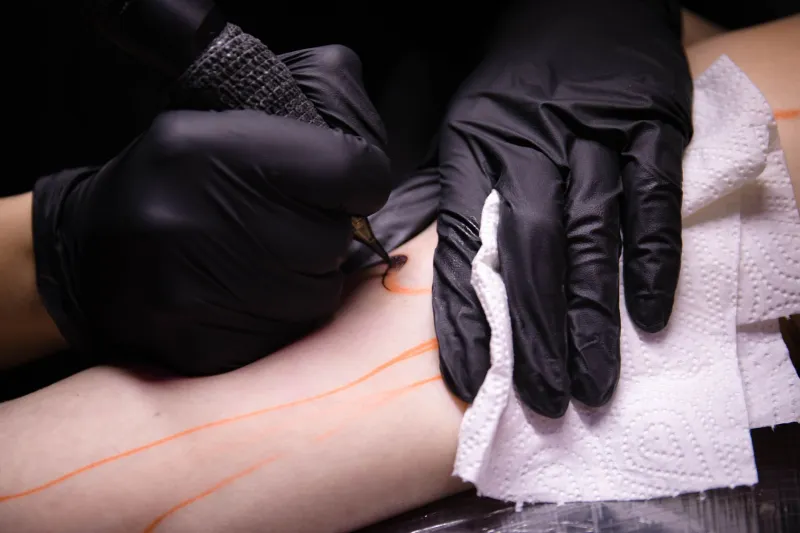
Walk into almost any respected tattoo studio in New York, Los Angeles, or Chicago right now and you'll find the same thing on the request list: script. Specifically, Arabic script. Flowing Ottoman calligraphy. Phrases that curve and breathe and stack in ways that Latin letters simply don't.
The demand is real, the waitlists are long, and the conversation around all of it is just getting started.
From Prison Yards to Fine Art Galleries
Arabic script on skin has a complicated American history. For decades, it showed up primarily in incarceration contexts — Arabic-speaking inmates tattooing religious phrases as protection, identity markers, or memory. It existed largely outside mainstream visibility.
Then something shifted. Social media gave calligraphy a platform it had never had. TikTok accounts dedicated to Arabic script art exploded in follower counts. Ottoman manuscript aesthetics started appearing in fashion editorials. And somewhere along the way, the visual language of Arabic writing — its curves, its density, the way words become almost architectural — captured a Western audience that had never looked closely before.
"People started seeing it and just... responding to it," says Hassan, a Brooklyn-based tattoo artist originally from Cairo who has been doing script work for over a decade. "Before Instagram, I was doing maybe two or three Arabic pieces a month. Now I'm booked out four months in advance, and at least half my clients aren't Arab at all."
What People Are Asking For
The requests run a wide spectrum. On one end: diaspora clients — second and third generation Arab, Turkish, Persian, and South Asian Americans — getting phrases in languages that connect them to grandparents, to homelands, to identities that felt distant growing up in the US.
These are often deeply personal commissions. A grandmother's handwriting, replicated in ink. A Quranic verse that someone grew up hearing at Fajr prayer. A line from Nazim Hikmet or Mahmoud Darwish that someone has carried around in their head for years.
"I tattooed a woman who had her late mother's recipe — in her mother's actual handwriting — converted into a tattoo on her forearm," says Zeynep, a Turkish American tattoo artist working out of a studio in Brooklyn's Bushwick neighborhood. "That one stayed with me for a long time."
On the other end of the spectrum: non-Arab, non-Muslim Americans who saw something beautiful and want it on their bodies. Which is where things get genuinely complicated.
The Gatekeeping Question
The tattoo community has been wrestling with cultural appropriation for years — Japanese irezumi, Indigenous symbols, Polynesian designs. Arabic and Ottoman calligraphy is the newest front in that debate, and it's not a simple one.
Tattoo artists with roots in the Arab world and Turkey are largely the ones setting the terms. Many have developed informal policies: they'll do Arabic script for non-Arab clients, but they won't do Quranic verses or phrases with direct religious significance. They'll help clients choose something meaningful rather than just aesthetically appealing. They'll refuse requests that they know — because the client doesn't — are grammatically wrong, phonetically embarrassing, or culturally tone-deaf.
"I've had people come in with a Google Translate screenshot asking for something that, when you actually read it, means something completely different from what they think," Hassan says, laughing but not entirely amused. "Part of my job is protecting people from permanently incorrect tattoos. Part of it is protecting the script itself."
This gatekeeping isn't universal. Plenty of artists — some from the region, many not — will do whatever a client wants without question. The internet has made it easy to find someone who'll say yes. Which is exactly why the artists who say no sometimes are, paradoxically, the ones with the longest waitlists.
The Reclamation Angle
For Arab and Turkish Americans, the tattoo trend carries a different weight entirely. In many Muslim-majority communities, tattooing is considered haram — forbidden. Getting inked can be an act of religious departure, cultural negotiation, or outright rebellion depending on the family.
But for a generation that grew up watching their heritage be exoticized, misrepresented, and occasionally weaponized in post-9/11 America, putting Arabic script on their bodies is something else: a declaration. A visibility choice. An insistence that this language belongs to them, not to the aesthetic marketplace.
"I grew up being told to hide that I spoke Arabic," says Dina, a 26-year-old Egyptian American from New Jersey who has three pieces of Arabic calligraphy tattooed on her arms. "Now I walk down the street and strangers stop me to ask about my tattoos. It's wild. It's also kind of healing."
Zeynep, who is herself tattooed in Ottoman script, frames it similarly. "Ottoman calligraphy was nearly erased when Turkey switched to the Latin alphabet in 1928. There are Turkish people today who can't read the script their great-grandparents used. When I put it on someone's skin, it feels like I'm doing something archival."
The Artistry Conversation
Separate from the cultural politics is a purely aesthetic reality: Arabic and Ottoman calligraphy is extraordinarily difficult to tattoo well.
The script relies on proportion, flow, and balance that took classical calligraphers years to master. Translating that to skin — a surface that moves, ages, and stretches — requires a specific technical skill set. Poorly executed Arabic calligraphy tattoos are common enough that they've become a cautionary tale in online tattoo communities.
"People see beautiful calligraphy and they think it's just pretty lines," Zeynep says. "It's not. Every letter has rules. Every connection between letters has rules. If you don't know the rules, you can't break them correctly — and in tattooing, you're breaking rules constantly to make the skin work. You have to know what you're doing."
The best artists in this space — and there are genuinely exceptional ones emerging across the US — are often people who studied calligraphy before they ever picked up a tattoo machine. Or who trained under masters from the region. The craft is demanding, and the clients who research before booking tend to end up with something that will still look right in thirty years.
What Comes Next
The script tattoo trend isn't slowing down. If anything, as second-generation diaspora communities grow and as American interest in Middle Eastern aesthetics continues to deepen, the demand will only increase.
What's shifting is the sophistication of that demand. Clients are doing more research. Artists are being more selective. The conversation between what's beautiful and what's meaningful is getting more nuanced.
And somewhere in that negotiation — between the artist and the client, between heritage and expression, between the sacred and the aesthetic — something genuinely interesting is being written. Permanently, on skin, in a language that has been beautiful for over a thousand years.