The Box Nobody Opens: What Lives Inside the Diaspora Closet
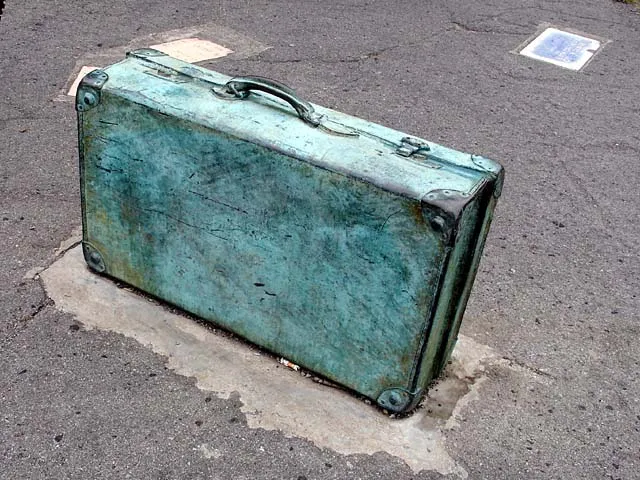
Photo: Linda Bailey, CC BY-SA 2.0, via Wikimedia Commons
My mother has a suitcase that has never been to an airport.
She bought it in 1994 for a trip that got postponed. It has been in the same closet, in the same position, for thirty-two years. It is not empty. It has never once held clothes.
The Suitcase Doctrine
Inside: two lace tablecloths, a folded embroidered runner still in its plastic sleeve, a stack of photographs in a rubber band, a coffee tin of buttons, a jar of something dark and probably fine, and a manila envelope that has been labeled in three different hands over four decades, each one less legible than the last.
When I ask what's in the envelope, my mother says, "Papers."
This is the entire taxonomy. Papers.
The Tea Set With the Stickers Still On
There is a gold-rimmed tea set — six cups, six saucers, a sugar bowl — that has been in the family since before I was born. It has never been used. Not once. The stickers are still on the bottoms.
The rule, as I understand it, is that the tea set is for guests. But when actual guests arrive, out comes the everyday set, because the tea set is for guests. There is a guest tier system in every diaspora household, and no one has ever produced documentation for it.
At some point the tea set stops being dishware and becomes a small, gold-rimmed monument to the belief that a better occasion is coming.
The Lace Tablecloth Has a Rank
In our house the hierarchy runs roughly: paper napkins, then the everyday cloth, then the good tablecloth, then the lace one, which has been deployed exactly twice — a wedding and a funeral — and was washed by hand both times. Some aunts rotate their lace tablecloths on a schedule so they don't yellow. Some just look at them.
Either way, the object holds a function that has nothing to do with eating. It says: we are the kind of family that has a lace tablecloth. Which is to say, we are still here, and we still do things properly.
A Plastic Bag of Receipts, and Why It Makes Sense
Now the part that looks like hoarding until you think about it for one minute.
There's a bag of documents. An old land deed with an official stamp. A passport from a country that no longer exists in that form. A school certificate with a photograph of a teenager who is now a grandmother. A hospital bill in a currency nobody uses anymore. A birth certificate with a misspelled name that has caused three separate bureaucratic nightmares and has never once been thrown out.
People who have lost things keep paper. It's that simple. A deed is not nostalgia; it's proof. A certificate is not clutter; it's evidence that a life happened somewhere else and was officially recorded. When your family's continuity depended on a stamp and a signature, you learn to keep the stamp.
The Unlabeled Box Problem
Here is the part that keeps me up.
Nobody wrote names on the back of the photographs.
There is a man in a suit, standing outside a building, squinting slightly. He is clearly beloved — he's in every stack — and no one currently alive can confidently say who he is. There's a picture of a picnic with eleven people and no year and no location. There's a baby photo that has been assigned to two different cousins by two different aunts, and the argument has never been settled.
The archive is complete and completely mute. We saved everything and labeled almost nothing, which means the objects survived and the meaning did not.
The Label Night
So here's the modest proposal, and I'm saying it to myself as much as anyone: pick a night. Any night. Put the photographs on the table, call the oldest person in your family, and write on the back. Full names. Approximate years. Locations. Whether someone is the brother or the cousin. Record the call on your phone if they'll let you — the voice is worth more than the caption.
Do it before the envelope gets another label in a fourth, less legible hand.
What Gets Passed Down
My grandmother's teapot will probably outlive me. The receipts will not survive a flood, and the land they describe belongs to a government that has changed its mind about such things before. None of this is actually about the objects.
What we keep, and what we refuse to throw away, is a small argument against disappearing. The suitcase doesn't travel. The tea set doesn't get used. The box stays closed because opening it means deciding what to do with it, and nobody is ready.
But the closet remembers. That's the whole point of the closet.